

Nay Pyi Taw, 3rd December 2025
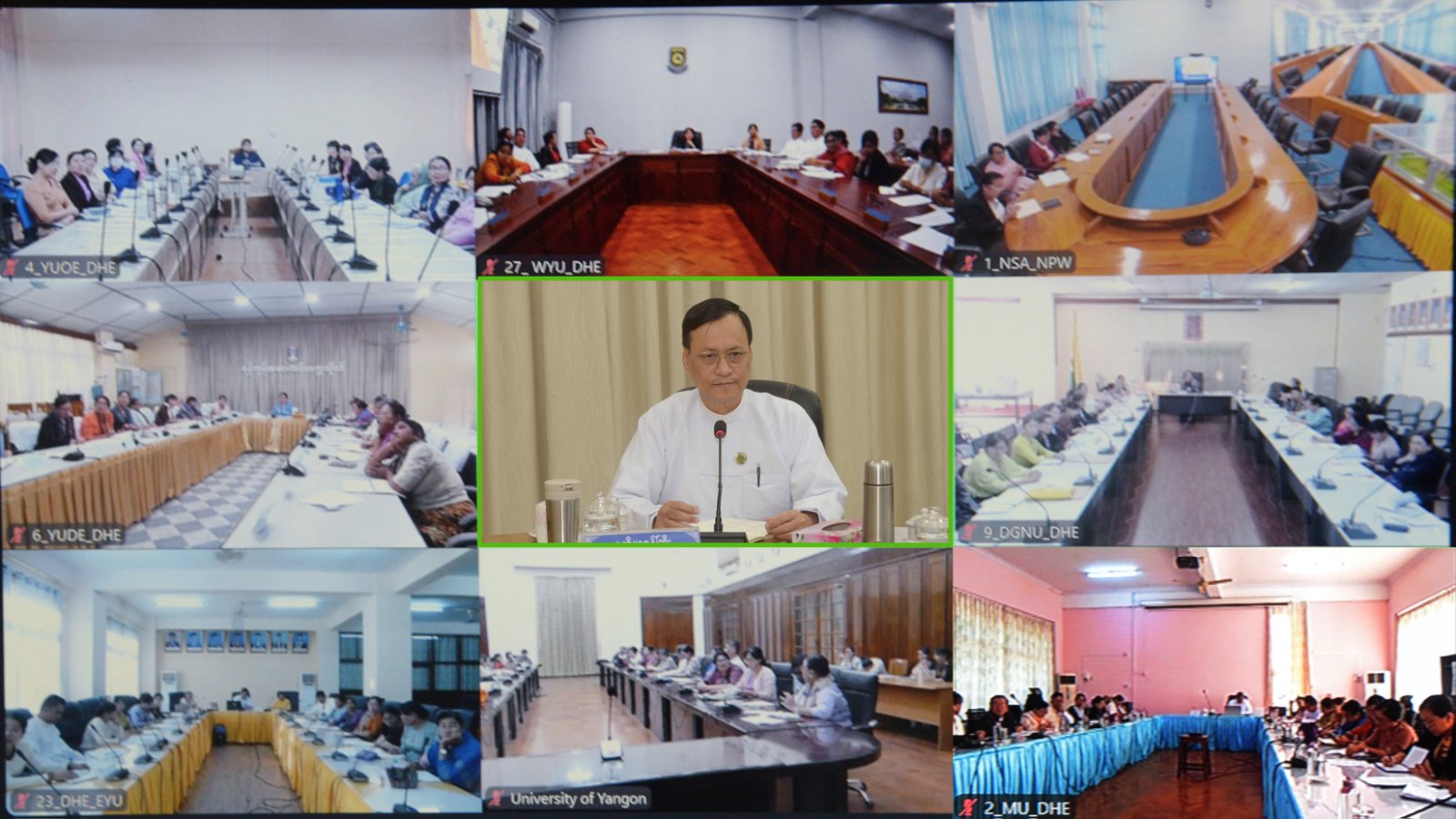
A coordination meeting was held this afternoon at the meeting hall of Office No. 13 of the Ministry of Education in Nay Pyi Taw for the successful organization of the Science Fair and the launching of skills-based training programmes aimed at improving employment opportunities for students who did not pass the matriculation examination.
The meeting was attended by the Deputy Minister for Education Dr Zaw Myint, Directors General, Deputy Directors General, and other officials concerned. The rectors, pro-rectors, and professors from six universities in Yangon and the University of Mandalay also attended the meeting online.
At the outset, the Deputy Minister stated that, in line with the guidance of the Union Minister, discussions would focus on organizing a Science Fair. It was followed by deliberations on launching skilled labour training programmes offered by various departments for students who did not pass the matriculation examination. Dr Zaw Myint noted that the Science Fair had traditionally been held at the University of Yangon but had been suspended since 2020 due to the COVID-19 pandemic. He further explained that the Science Fair is planned to be revived in January 2026 in full swing, featuring engaging subject-related exhibitions, displays, and competitions. He also encouraged the participants to propose ideas for jointly organizing the Myanmar Academy of Arts and Science Research Conference together with the Science Fair to ensure a significant event.
Subsequently, the rectors and officials concerned discussed proposals for setting up science exhibitions, during which the Deputy Minister provided additional suggestions and guidance as necessary.
In the second session, the Deputy Minister elaborated on plans for universities under the Ministry of Education to offer Job-Ready Skills training programmes for students who did not pass the matriculation examination, with the aim of creating employment opportunities that benefit the country and local communities. He also explained plans to offer training courses on laboratory-scale production methods for import-substitution products.
Following this, directors general and rectors made their suggestions regarding the proposed training programmes. The Deputy Minister discussed the requirements and coordinated the necessary measures, it was learned.